

I’m still pinching myself, wondering if a day such as today truly happened.
So casually, I sat and ate with Padma Shri awardee Ustad Shahid Parvez Khan Saab.
And I kept thinking—In what world does someone as ordinary and, in comparison, so uncultured as me get to sit beside souls who have dedicated their entire lives to an art form so pure, so ancient, and so profound as Indian classical music?
Yet, there I was.
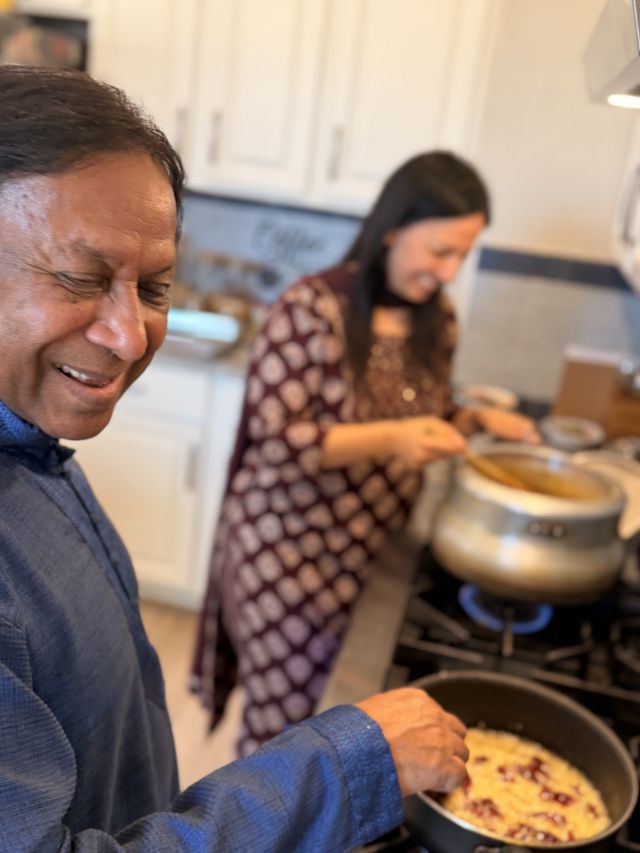
Recording, chatting away, and watching a Padma Shri awardee and maestro cook for his students and feed them like his own children.
A seventh-generation maestro carrying forward the ancient Guru–Shishya Parampara. A man whose greatness is not confined to the stage, but is felt in the way he teaches, nurtures, and gives.
What does it really mean to be a Padma Shri recipient?
The Padma Shri is one of India’s highest civilian honors, awarded in recognition of distinguished contributions across various fields, including the arts.
Ustad Shahid Parvez Khan Saab received the prestigious Padma Shri in 2012 for his exceptional contribution to Indian classical music as a sitar maestro.
But standing in his presence, I realized something.
The award itself is not the story. It is a symbol of the journey.
A journey that, in many ways, feels like a gift from the universe.
He belongs to the seventh generation of the Etawah Gharana, also known as the Imdadkhani Gharana, and was trained by his father and guru, Ustad Aziz Khan Saab.
He was born into a remarkable musical lineage—but he did not simply inherit that gift. He honored it.
Through years of dedication, discipline, and immersion in the world of the sitar, he transformed that inheritance into a lifetime of mastery.
He has received numerous honors, including the Sangeet Natak Akademi Award. He is known around the world as “The Man with the Singing Sitar” for his extraordinary ability to bring vocal nuances and human emotion into the instrument.
But what moved me most was not the list of awards.
It was witnessing “The Man with the Singing Sitar” in his element, on stage at the annual Guru Purnima celebration.
It was witnessing what happens when a human being dedicates an entire lifetime to mastering something so beautiful—and then chooses to make that rythm bounce back in his disciples and audience hearts.
It felt as though the universe had entrusted him with this ancient art, and he had accepted the responsibility with complete devotion.
The Sitar is not just an instrument. It is a language of the soul.
The annual Guru Purnima celebration hosted by SPK Academy, under the direction of Seema Gulati, was a phenomenal presentation of Ustadji’s teachings.
People who have never attended one of these gatherings may find it difficult to understand what I mean when I say it was uplifting.
But imagine carrying the weight of loss, fatigue, daily responsibilities, and layers of accumulated stress—and then entering a space where the sound of the sitar seems to gently rearrange something within you.
You leave feeling lighter.
Not because life has changed in those few hours, but because your frequency has changed.
And perhaps that is one of the most beautiful gifts of music.
Why is learning an instrument not a part of everyone’s life?
I found myself wondering: Why isn’t learning an instrument considered an essential part of growing up—or simply of being human?
At SPK Academy, I saw something that stayed with me.
Students ranging from 4 years old to 80 years old.
And these are not people merely dabbling in a hobby. Many are learning, practicing, and performing on stage.
Doctors, lawyers, CPAs, HR professionals, IT professionals, homemakers, and people from so many different walks of life.
Students from Indian, American, Japanese, Filipino, and Spanish backgrounds. People traveling from Washington, Virginia, California, Pittsburgh, and many other states.
How is that even possible?
What is bringing together people who are so different in age, profession, culture, and life experience?
I spoke with quite a few students, and the answer became clear.
The love for Ustadji’s teaching.
His ability to make the sitar feel approachable. His way of helping students discover that music is not merely about producing notes—it is about expressing what they feel through those notes.
And perhaps that is why this academy feels less like a school and more like a family.
A family I feel incredibly fortunate to have become associated with.
A privilege that may be closer than you think
There are people in India who wait in lines for the opportunity to meet Ustad Shahid Parvez Khan Saab.
And here, in our own Phoenix community, we have the extraordinary privilege of learning directly from him.
Think about that for a moment.
A living legend. A seventh-generation maestro. A Padma Shri recipient. A guru carrying forward centuries of musical tradition.
And the opportunity to learn from him is not some distant dream reserved for a select few.
It is here.
Perhaps you have always wanted to learn a musical instrument, especially the sitar, but kept telling yourself:
“One day.”
“When I have more time.”
“When the children are older.”
“I’m too old to start.”
But what if the instrument you have been postponing is not merely a hobby waiting for you?
What if it is a new language waiting to be discovered?
A source of joy. A discipline. A way to quiet the mind. A connection to something ancient. And perhaps, a part of yourself you have not yet met.
Imagine looking back years from now and realizing that you could have started learning from a maestro like Ustadji—but you kept waiting for the “right time.”
That would be a much greater regret than beginning as a complete beginner.
So, if the sitar has ever called to you—even quietly—perhaps this is your moment to stop admiring the music from a distance and begin discovering what it feels like to create it yourself.
And if you have children, imagine giving them something that can stay with them for a lifetime—not just a skill, but a relationship with music, discipline, culture, and beauty.
Some opportunities are worth acting on before they become memories.
This is one of them.
I wholeheartedly encourage you to connect with SPK Academy and explore the opportunity to learn directly from Ustad Shahid Parvez Khan Saab.
You never know.
The first time you hold a sitar may be the beginning of a journey you never imagined your life could hold.


Discussion
0 commentsBe the first to share your thoughts on this story.